Airports are places of transition. Some people arrive, others leave, and in between, small stories unfold that no one notices and that disappear almost as soon as they begin. Yet sometimes, amid the familiar noise, suitcases, departure boards and reunions, something happens that does not seem to belong to the predictable order of an ordinary day of travel. That day in Zurich, I had no idea that a routine wait was about to become an encounter whose significance I would only begin to understand much later.
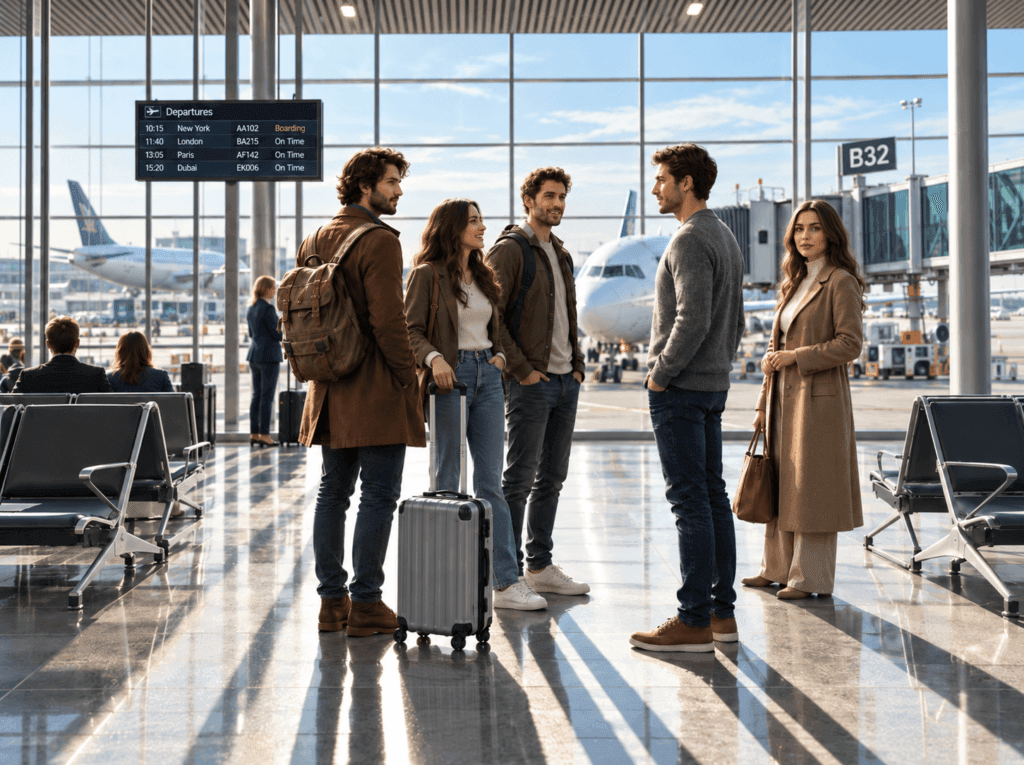
One of the best things about Zurich Airport was its enormous glass walls. Through them, we could see the baggage reclaim hall, where newly arrived passengers crowded around the conveyor belts hoping their suitcase would be among the first to appear—an entirely exclusive thought that almost nobody ever has. Note the irony. It was also a place where the usual minor squabble between tourists was never far away; an episode that often delighted those of us on the other side of the glass who, bored by the wait, found in those confrontations—where sparks flew but little else—a perfectly legitimate form of entertainment. People watched expectantly—who knows, perhaps some even placed bets—to see whether things would finally turn ugly or whether it would be yet another threat that came to nothing. “Bread and circuses”: the old motto was still alive and well. For some of us, however, the spectacle was unbearable. We understood that shaving a minute off the wait was not going to extend anyone’s holiday. Nor did it guarantee escaping customs, where it was remarkably easy to lose whatever time had been gained. Under those circumstances, my friend suggested that we go for a coffee at a restaurant nearby. “God, they’re exhausting. Let’s get out of here,” he exclaimed, irritated by yet another performance of that “cockfight” in which everyone seemed to crow loudly without ever actually using their spurs. Needless to say, in certain respects my friend and I were quite alike. His irritation was more than obvious, so I readily agreed to move away from the area, hoping the walk there and back would calm his mood. On the way, we chatted about our upcoming holidays, the occasional setback we had suffered here and there, and those few incidents that, with the passage of time, had found their way into the category of amusing anecdotes. They were recurring subjects in an airport that often served as a disguised emotional painkiller, because simply talking about travelling somewhere different was enough to send our thoughts on flights of their own towards paradises we would probably never visit. One of Theo’s virtues was his punctuality, worthy of a Swiss watch, a quality that bordered on obsession whenever he found himself in crowded places. That was why he hurriedly finished what he had ordered and suggested that we return to the glass wall immediately. During the time we had been sitting there, I had noticed that he never once took his eyes off the enormous electronic board suspended from the ceiling in the middle of the concourse, displaying arrivals and departures in real time. Truth be told, he did not have to insist much, because in that respect we were very much alike. We set off, quickening our pace so that we could take up position. The plan was to get into the front row and watch Luca make his entrance. Any moment now, his head should appear from one of the numerous passageways leading into the central hall. We soon spotted him emerging from one of the tunnels, crossing an open walkway bordered by transparent glass railings: thoughtful, dragging his feet as though reluctant to return to the tedium of everyday life and bury il dolce far niente right there at the airport. He then began descending the stairs that led directly towards the correct baggage carousel. The moment he saw us, he started waving his hands and pulling exaggerated faces, suggesting that we would have to see what kind of mood the “Roboticops” were in; that was the name we used for the officials manning the checkpoints. There was no doubt about it: our friend had been thinking about them too, since ultimately he was the one who had to deal with the situation. We simply crossed our fingers in an exaggerated fashion so that he—and everyone crowded around us—could see the gesture. It delighted several people nearby who understood what it meant and smiled at the appropriateness of our little performance. We looked at one another, nodded silently and started walking towards the metal barrier a few metres from the exit: the invisible frontier separating those of us waiting impatiently from those arriving with their heads raised, searching for familiar faces. Even from a distance we could see that Luca looked radiant: enviably tanned and wearing the expression of someone who had genuinely switched off from everything and enjoyed a proper holiday. The arrivals terminal always produced the same bittersweet feeling in me. On the one hand, the enormous joy of seeing someone again; on the other, a faint sting that appeared timidly, only to vanish as soon as I saw the person approaching with that infectious vitality. To this I had to add my own reluctance, fed by the daily routine that pressed its heavy boot down upon me, mercilessly reminding me of an ordinary life that never seemed to change. Then came what should initially have been a quick formality but instead turned into another tedious wait of at least thirty minutes until, finally, Luca—like a prisoner suddenly granted parole—shot through the automatic smoked-glass doors wearing the expression of a slaughtered ram. His little performance made us laugh and immediately told us that passport control had given him a hard time, something he confirmed while we hugged him in welcome and complained about the long wait. We headed towards the car park. There was no time to lose: the parking charges were outrageous. One of the traps in the system was that once the first sixty minutes had passed, the cost soared with every additional hour. That shameless robbery infuriated me, disguised as security and surveillance when in reality all they were doing was providing three or four square metres of ground on which to leave a vehicle that required neither attention nor additional service. A perfect business for some people: minimal maintenance costs, clean daily profits and almost no effort. On the way to the car, Luca began telling us about the commotion that had erupted inside the terminal before he met up with us. First came the baggage drama, with the suitcases taking forever to reach the conveyor belts, followed by chaos in the passport-control queues. A handful of confused tourists had joined the wrong line and created monumental disorder, upsetting the delicate balance that had already been close to breaking point. The atmosphere, already tense, grew even hotter with mutual accusations: some blamed others for having disrupted the queues. The lines were organised with Swiss precision: one for residents, another for citizens of the European area and a third for the rest of the world. Apparently, the cleverest among them—pretending to be confused after noticing the queues were of very different lengths—rushed towards the shortest one until they were informed that they were standing in the wrong line. The remaining travellers pointed towards the signs above the passport-control entrances, written in several languages; naturally accompanied by grimaces, indignant noises and middle fingers appearing in every direction. The opportunists, unwilling to admit that they had pushed their luck far too far, fixed their eyes on the backs of the people in front of them and pretended not to hear. As everyone else watched them with mocking smiles, they experienced a sudden rush of wounded pride and attempted to slip into the middle of the correct queue, shamelessly cutting in front of everyone. Naturally, the response was immediate: they were called “cheeky bastards” and several other colourful things that most people could not understand because the cocktail of languages was considerable. The place became the scene of a “cockfight” which, judging by Luca’s description, sounded far more like an entire chicken coop. It was a commotion that completely ignored the fact that they were only a few metres from airport police control, where, had matters escalated, they could simply have been refused entry. Finally, Luca added that the customs officers, annoyed by the hostility generated during the verbal confrontation—which, thank God, did not go any further—became exceedingly meticulous and subjected everyone involved to especially unpleasant inspections. According to Luca, the search was so exhaustive that they looked as though they were inspecting terrorist prisoners at Guantánamo Bay. That final remark, hilarious but wildly exaggerated, made us burst out laughing. The melodramatic weight he gave the story was unbeatable. On the other hand, we understood his situation and his need to release the accumulated tension, so we let him talk without interruption and allowed him to get everything off his chest. He told the story so well and with such conviction that he sounded like a professional radio presenter entertaining his listeners—in this case, the two of us, doubled over with laughter at his almost delirious observations. It felt as though we were listening to a comedy sequel to Raiders of the Lost Ark…
At that point, we still believed Luca’s story and the chaos surrounding his arrival were the only remarkable things about that morning. We were wrong. Airports are full of people looking at one another without ever truly seeing each other, and sometimes a single gaze is enough to make someone cease being just another anonymous face in the crowd. As we laughed and walked towards the car, we had no idea that someone was already watching our little scene with an interest far more deliberate than the casual curiosity one gives to passing strangers. Before long, what had seemed like an ordinary reunion would acquire an entirely different meaning. And that was where the real story of the Envoy began.

About the author
Alfonso Corchero is the author of Between Asphalt and Incense, a work born from experience, observation, and an inner search. His writing explores the contradictions of human nature, the moments when everyday life fractures, and those experiences that compel us to look within. Rather than offering ready-made answers, his stories invite readers to recognise themselves in the journey, the doubts, and the transformations of someone learning to cross their own thresholds.