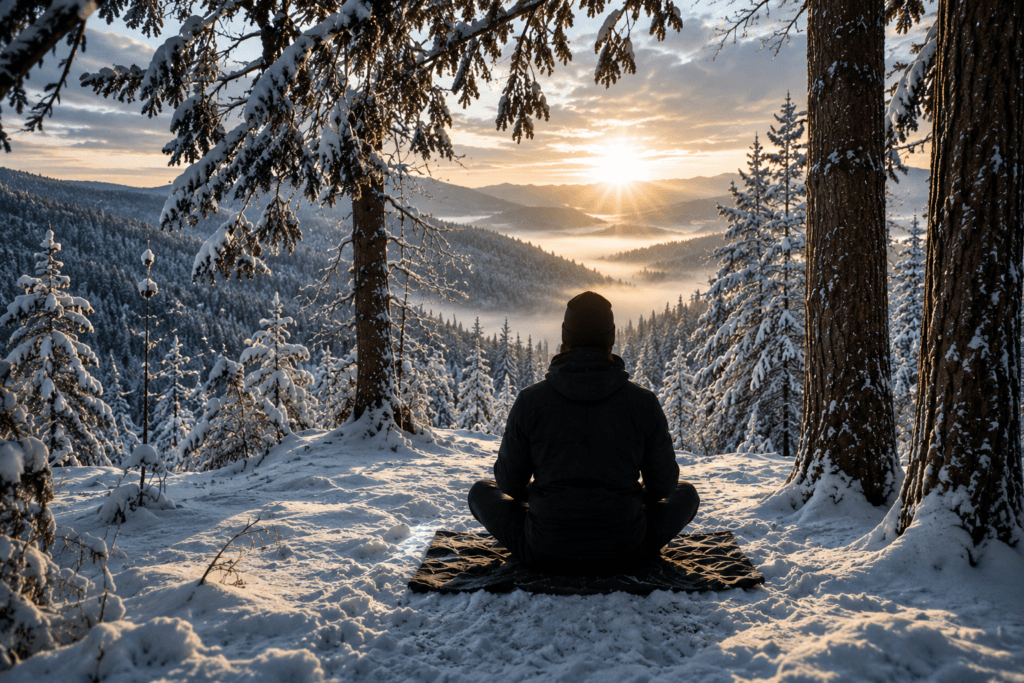
There are places that eventually acquire a meaning no map could ever record. Places we return to not only because of their beauty, but because something within them seems to answer a need that is difficult to explain. During a decisive period of my life, I found one of those places in the forests of the Lägern Ridge, north of the canton of Zurich. There, among snow-covered trees, sub-zero temperatures and a silence barely disturbed by the wind or the animals, I established what I eventually came to call my “headquarters”. Three trees, three specific points in the forest and a practice that, over time, ceased to be merely meditation and became a way of exploring the changes taking place within me. But nature was never simply a backdrop. At times it seemed like a refuge; at others, a teacher; and occasionally even a presence with a peculiar sense of humour. Between states of profound connection, doubts, minor scares and unexpected encounters with the wild, those excursions gradually became an experience far more difficult to explain than to live. This is one of those stories. Winter cold spread across that beautiful natural setting, a place I visited whenever I could find a gap in my personal schedule. Considering the time of year, it looked magnificent and, at the same time, desolate: a landscape covered by a thick layer of snow in the middle of one of the many forested areas north of the canton of Zurich. It was a captivating scene, both for the pristine white covering the frozen ground and for the trees and plants, which seemed wrapped in a layer of cotton. A visual spectacle difficult to equal; images often seen on postcards of the Swiss Confederation, with mountain landscapes suspended between purity and stillness, evoking a profound sense of peace. It was desolate as well because, as I ventured along one of the paths disappearing into the dense woodland, I realised there was not another soul in sight. Hardly surprising, considering the temperature must have been hovering around zero degrees Celsius or perhaps even below freezing. The curious thing was that the cold seemed to disappear the moment I spread out a plastic bag to sit on the snowy ground and rested my back against one of the three trees I had chosen as my guardians during my frequent visits to that magnificent place. That was the spot I had selected as the ideal setting in which to surrender myself to deep meditation, connecting with nature in a genuine way. At times I reached states in which I felt as though I were merging with my surroundings. In those moments, losing all sense of time was common, as I dissolved into spheres of consciousness where I temporarily surrendered my identity. I completely forgot that, although usually quiet, this was still a public place crossed by hikers and inhabited by all kinds of animals, birds and other creatures. Sometimes they were the unwitting ones responsible for bringing me back to the earthly reality I so often abandoned, immersed in realms from which I extracted whatever I needed to continue forging that delicate and demanding transcendent path. Those abstractions could last minutes or hours. I followed no rigid rules and never forced myself to continue if inspiration was absent. Instead, I surrendered to the moment, flowing with emotions and thoughts that sometimes lifted me towards the heavens and at other times dragged me into hell. Added to this were less decisive external factors such as the position and intensity of the sun, snowstorms, air temperature and countless other details. On rare occasions, my emotional state—subject to the fluctuations inherent in human nature—slid across an unstable surface of certainties and absurdities, guilt and sorrow, fears and doubts, turning meditation into a form of torture; something difficult to accept. As I mentioned earlier, in what I already considered my “headquarters”, I had three trees located at strategic points, depending on where I felt I should settle whenever I went there to connect with the elements. The first stood at the top of a rocky outcrop from which an extensive view of the lower valley, a few kilometres away, could be seen. The second was about a hundred metres farther down the path; the third, in turn, stood roughly fifty metres beyond the second. This last one, however, was less visible from the dirt track crossing that particular part of the “enchanted forest”. The inner transformation I was experiencing did not allow me to measure precisely who I was becoming, because it was not something that could be resolved simply by looking into a mirror. For the people around me, however, it was more instinctive: they sensed that something had changed… but what? In my presence, they could tell that I was no longer the person I had once been, and that fact caused a certain rejection. They knew nothing of my frequent escapes into the forest and had no idea about the exponential increase in mystical experiences that were secretly transforming me from the inside out. Let us say that those close to me lacked the ability to discern the metamorphosis itself, but they noticed its peripheral manifestations: my physical appearance, the way I behaved or spoke, the radical changes in my eating habits and many other things. All of it was wrapped in an aura of mystery that made them uncomfortable, though apparently not uncomfortable enough to investigate why those changes were occurring. Telling themselves that such subjects gave them the creeps was explanation enough. “Better not get too involved, in case we hear things that force us to question our way of life.” On the other hand, there was another factor that caused me confusion, and it had to do with my own perception. Because I was living the process with such dedication, I could find no way to measure its scope or understand how the image of my “self” was being projected into the outside world. In the end, I could not see myself except through the eyes of others, which made that vision far from precise, considering that not everyone looks at you favourably. What entering into resonance with nature as a source of life awakened in me was another matter entirely. Not in an ideological sense, nor in connection with environmental theories—so characteristic of prevailing human discourse, which I did not share and from which I felt poles apart. For me it was something simpler and more intuitive: a genuine bond that made possible a selfless exchange through the subtle fabric of the natural field surrounding every living being, what many people know as the aura. There were days when the connection became so intense that words fell short. Any analogy would have sounded forced, like trying to catch air with your hands. It was something that simply happened: inexplicable yet real, as though the forest and I had become one. It could perhaps be understood as an osmosis between my own ecosystem and the subtle planes of the plant world, or as a displacement of consciousness to somewhere else while my physical body remained seated on the ground, spine upright, facilitating the flow of energy. What remained bewildering was the disparity of results from one day to the next: sometimes I became lost in unfathomable inner layers to the point of not knowing whether I was even breathing; on other occasions I could not concentrate at all, trapped in internal debates that led nowhere. Then there were days when failure was caused by extreme external factors, such as powerful gusts of icy wind that made me shiver uncontrollably. They also violently shook the tree branches above me, threatening to break and fall onto my head. To this I would add what I came to call the heavy-handed jokes of the “spirit of the forest”, which, on a few memorable occasions, dumped a great pile of snow onto my head from the treetops before I had time to react. First it frightened the life out of me, then left me trembling from the cold. These were minor mishaps one had to expect when venturing into frozen woodland far from the paths that crossed it. Such “practical jokes” did not occur only during snowstorms; they sometimes happened in bright sunshine as well, making the episode feel even more treacherous. The cap of snow would silently loosen as it melted and drop from the crown or branches of the trees. Fortunately, in those cases the snow was less compact and the blow considerably gentler. At this point, I need to clarify something fundamental: in my view, nature possesses a more ethereal component that many people deny because they cannot see it, although they may indeed be capable of feeling it; of that I am convinced. I am referring to the countless legends, fables and myths surrounding nature spirits: fairies, gnomes, goblins, sylphs, undines and all manner of beings that, according to stories from ancient cultures, inhabit forests, rivers, seas, the underground world and the air. Who knows whether they are imaginary, or whether they simply reveal themselves only to certain kinds of people? Perhaps it depends on some particular ability that allows a person to see them or interact with them. This is not my case; nevertheless, as a way of attempting to explain the composition of invisible structures and the laws by which they may operate—represented by the elements of earth, fire, water, air and ether—I consider it a conceptual possibility worthy of serious consideration. Elementals or no elementals, whenever circumstances allowed it, I set off without giving the matter much thought. The moment I reached the “enchanted forest”, located on the so-called Lägern Ridge, I felt at home, surrounded by a silent companionship that never judged me. If there is one thing I wish to emphasise, it is those visits to my headquarters during which something out of the ordinary occurred; moments worth framing, such as the occasions when I established fleeting but intense contact with the wild animal world. And that was precisely what happened on one of the days when I decided to go despite the bitter cold and high humidity, conditions that discouraged spending too long outdoors. I concluded that this particular visit would be brief. With time, I understood that my “headquarters” did not consist merely of three trees scattered through a Swiss forest. The true territory I was exploring lay elsewhere, in that imprecise frontier where external silence begins to reveal the noise we carry inside. I never knew with certainty how much of those experiences was truly extraordinary and how much belonged to a perception that was transforming along with me; perhaps it is not even necessary to resolve that question, because some experiences lose their value the moment we dissect them in search of a definitive explanation. What I do know is that I kept returning: for the silence, for the snow, for that strange feeling of belonging and also for the unpredictability. The forest could offer me a profound experience or leave me trapped for hours inside my own thoughts; it could wrap me in absolute stillness or, quite literally, dump a pile of snow on my head. And perhaps that was part of its teaching: nature never promised to give me what I was looking for, yet almost always ended up showing me something I needed to see. Sometimes it did so through silence. Sometimes through discomfort. And occasionally, through an encounter so unexpected that it forced me to look at everything I thought I understood from an entirely different perspective. That day would be one of those occasions. I had entered the forest expecting solitude, but the forest had something else waiting for me. And once again, I was about to discover that the most important journeys rarely announce themselves before they begin.

About the author
Alfonso Corchero is the author of Between Asphalt and Incense, a work born from experience, observation, and an inner search. His writing explores the contradictions of human nature, the moments when everyday life fractures, and those experiences that compel us to look within. Rather than offering ready-made answers, his stories invite readers to recognise themselves in the journey, the doubts, and the transformations of someone learning to cross their own thresholds.