When I parked the car two streets away from the address marked on the map, I took the paper into my hands again as though it were something precious.
Inevitably, at that moment, the memory of Martina and her recycled-paper envelope loaded with dynamite burst into my mind, the one she had handed me as though the whole thing had nothing whatsoever to do with her.
I believe I have already mentioned how extraordinary the universe is; in case I have forgotten, I will do so now, so that it may be placed on record:
the universe is wonderful!
This envelope, however, which I was gripping between my fingers, was made of slightly padded cotton that felt like fine cloth.
‘Pillowy, Mr Kiran,’ good old Kasun would have said had he been sitting beside me in my new car.
With a burgundy ribbon crossing the seal in the shape of a cross, made of a material that felt metallic to the touch, rather like aluminium foil, the envelope gleamed like the sun itself when the last rays of evening struck it, just before the king of the heavens withdrew to rest.
On my way to the venue — marked on the map with a red circle — I kept wondering how I was going to manage to socialise during the evening.
My English had not improved one iota during those two months and that, there was no doubt about it, represented a serious obstacle. Worse still, there was no guarantee that all the Sri Lankan guests spoke it fluently, or even that they would feel inclined to make the effort.
I knew perfectly well that when people of the same nationality gather in a foreign country, they tend to retreat into their mother tongue so that they can communicate comfortably.
If we added to that the fact that this was a traditional wedding banquet, with the entire family and close acquaintances — some of whom had travelled all the way from Sri Lanka expressly for the occasion —, the chances of finding a European guest were remote; those of coming across a Swiss person, frankly, nil.
As I turned into Morgentalstrasse, I suddenly came upon an enormous commotion of people packed together in front of a huge black metal gate. I stopped dead when I realised that, that evening, I was going to feel like a lemon dropped into a crate of oranges.
Stage fright struck me — not enough to paralyse me, but certainly enough to make me stop for a few moments before joining the group.
I needed to take a careful look at what, from a little over twenty metres away from the gate, seemed to me like a genuine spectacle.
I do not think I am exaggerating when I say that in my entire life I had never witnessed such a display of colour and elegance taken to such a degree of excellence. I was glad I had stopped on that corner; I wanted to imprint on my retina an image that surpassed in fantasy anything I had ever written in my stories.
Above all because of the cultural factor: once I was among them, I would no longer be able to examine the details with such minute attention.
The gentlemen, broadly speaking, followed a formal dress code: trousers and jackets in sober shades — black, navy blue or grey — and ties in most cases. What stood out most were the gold wristwatches — who knew whether they were made of real gold — and the discreet pins on ties and lapels, adorned with sparkling gems but without ostentation.
The ladies, on the other hand, were a chromatic spectacle difficult to rival: an explosion of colour in their outfits, with masterful embroidery in silver, gold and every imaginable shade woven together.
Many wore the traditional osariya — that flowing drape with its characteristic frill at the waist — in creams, golds, deep reds, emerald greens or rich blues. They were laden with jewellery that glittered in the evening light: layers of chains, elaborate pendants, thick bangles and forehead ornaments that gave them an almost aristocratic Eastern air.
Once I had managed to appease my most pressing curiosity, I decided to move closer and join the group waiting for the bride and groom’s triumphant entrance. There were still a few rays of sunlight left, though already mild, so I chose to keep my sunglasses on: a discreet way of observing everything around me without attracting too much attention.
Although, judging by the way they had been watching me — every last one of the guests — ever since I joined them, my attempt to go unnoticed proved fairly useless.
After a couple of minutes, they seemed to accept my presence at the banquet, as some of the men began to smile.
The truth was that, surrounded by so many curious Sri Lankans, I felt like a genuine circus monkey. The women were considerably subtler in the way they looked, but no less nosy for it.
What does one do in a situation like that? ‘Smile, darling,’ dictated the voice of my intuition. So I activated ‘warship radar’ mode: I turned my head from side to side, brandishing a fresh smile, without lingering on anyone in particular, spreading my attention around as though sweeping the horizon.
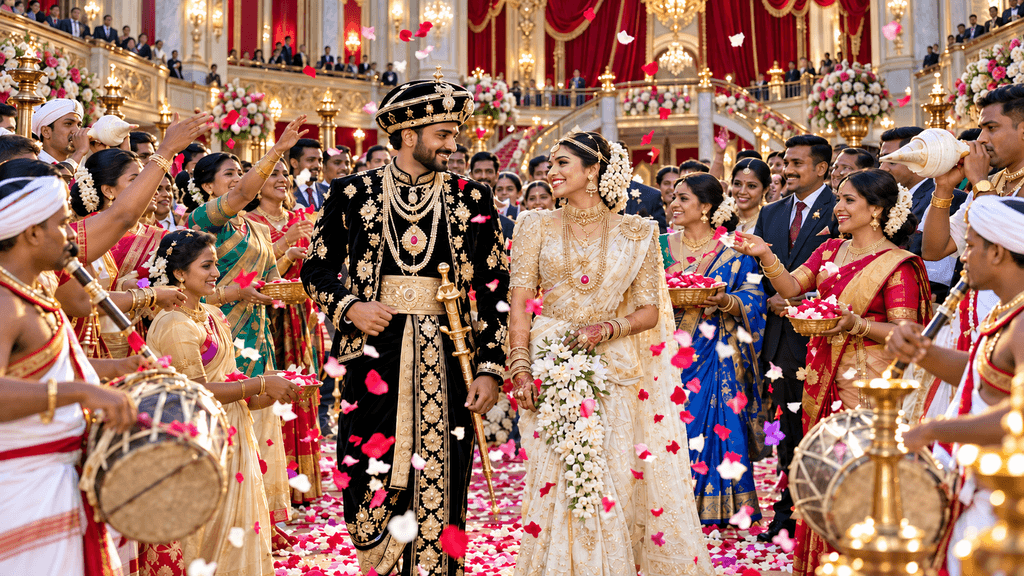
Suddenly, a general clamour erupted and everyone turned their heads in the same direction. There was no doubt about it: the bride and groom were about to appear. With a sharp thud followed by a tremendous screech, the metal gate swung wide open.
The drums began at once — a joyful, deep rhythm that settled directly in the chest. This was followed by a high, vibrant, prolonged trill from several of the women present, charging the scene with such overflowing emotion that it seemed as though they were about to take flight… and I with them.
They raised their arms in unison and positioned themselves on either side of the gate, forming a perfect human corridor for the imminent arrival of the fortunate pair. I took advantage of that instant of collective frenzy to cast my eyes over the women nearest to me; more specifically, over the magnificent saris with sharply defined front pleats and long trains — in deep reds or ivory with gleaming gold embroidery — in which they were dressed.
As they raised their arms to form the corridor, extraordinary henna tattoos covering their hands and forearms came into view; on some of them, even their fingers bore floral patterns that seemed to come alive beneath the light of the setting sun.
Nor could I overlook the graceful nathori: those delicate gold chains connecting the nose piercing to the ear piercing, forming an elegant curve along the cheek. They were by no means modest pieces; judging by their size, weight and the number of links and pendants, I assumed they were jewellery reserved for occasions as special as this one, not something for everyday wear. They must have been uncomfortable, but the women wore them with a naturalness that took my breath away.
Then deep, resonant trumpeting sounds began to ring out, though I could not see their source from where I stood; later I learnt that they were seashells used as ceremonial instruments.
Their sound was deep, ancestral, almost hypnotic. Then, with slow, solemn steps — like princes of the East entering a palace —, Sanduni and Kasun appeared.
What elegance! What magnificence!
It was an immense privilege to behold an image so inspiring and, at the same time, so tender. I hardly know where to begin in describing that scene overflowing with light, colour and an unmistakable nobility that left me astonished by the richness of its nuances.
Beginning with Kasun: he wore his black nilame outfit embroidered in gold and gleaming leather shoes. Around his waist was a very broad sash with golden buckles called a kamarabandha — as I was told afterwards —, which he matched with several gold chains around his neck and an ornate brooch on his lapel, its stones sparkling like tiny stars.
The jacket bore an obvious resemblance to a British colonial military uniform — structured shoulders, fitted cut, dense embroidery —, but to complete the regal effect, a ceremonial Eastern sabre with a golden hilt and an elaborately worked scabbard hung at one side of his waist.
At the cuffs, beneath the sleeves of the military-style jacket, magnificent cufflinks with stones set in gold peeped out, catching every glimmer of light.
Not forgetting the turban, or thoppiya: made of black velvet, with dense embroidery in gold and silver, ornamental motifs and a raised central adornment at the front that stood like a majestic crest. In short, rather than a turban it resembled a low, padded four-pointed crown, worthy of a nobleman from the ancient kingdom of Kandy.
Now let us talk about the bride, Sanduni, whose beauty was almost inconceivable. She wore her traditional osariya: six metres of fabric in shades of cream, biscuit, ivory white and very pale gold. The fabric was lavishly woven with threads of gold and silver, pearls, sequins and gemstones forming floral motifs and symbols that were unknown to me.
The style was unmistakable: the characteristic neriya — a gathered, voluminous frill around the waist —, the pota — the loose end of the sari gracefully draped over the left shoulder — and a fitted, round-necked blouse that gave her a noble and modest air.
All of this was combined with impressive, heavy jewellery — as though she were carrying the symbolic weight of a thousand-year-old tradition — and multiple layers of gold chains that gleamed with every movement.
The pendants, or padakkam, were elaborate: swan motifs, floral symbols of prosperity and the powerful makara — that mythical creature, half fish and half dragon, guardian and protector in Sinhalese mythology.
Close to her neck she wore the karapatti: a broad, majestic collar fitted closely like a choker, with a large central pendant from which an exceptional stone stood out: a brilliant red gem. Then came the peti malaya, the longest chain of all, whose name literally means ‘garland of petals’.
It was made of delicate links shaped like pumpkin seeds and encircled the other necklaces like an outer garland, hanging down to the waist or even lower and creating layers that gave volume and a cascading effect across the chest.
On her left shoulder she wore the haritchiya: a large, elaborate ornamental brooch, set with stones and mythical motifs, which secured the draping of the osariya precisely so that it would not slip, while at the same time adding a brilliant focal point.
On her hands and arms she wore thick, layered bangles, with large links of red coral and gold engraved with intricate patterns; hoops set with red gems climbed up her forearms. Sparkling rings on several fingers and delicate anklets that chimed softly as she walked completed the magnificent ensemble.
Taken as a whole, Sanduni did not look merely like a bride: she was a powerful vision, like a muse from the ancient kingdom of Ceylon materialised at the beginning of the twenty-first century.
The combination of the osariya with that cascade of gleaming gold created a magical contrast between the softness of the fabric and the opulent weight of the jewellery, all beneath the light of the setting sun, which made every detail of her attire sparkle. It was only natural to be mesmerised.
The blouse, although more flowing than the groom’s, retained a noble, palatial air. Its dense embroidery — in gold, silver and subtle touches of colour — evoked precisely the luxury I had imagined in my story for Queen Amoria: opulence without crude ostentation, a splendour that seemed to emanate from ancient courts without any need for military rigidity, only pure elegance.
At the cuffs, exquisite details stood out: gemstones set in gold and hanging pearls that caught the light, adding a living brilliance to her movements. Nor should I forget the main headdress: a frontal ornament positioned at the centre of her forehead, with a prominent teardrop-shaped pendant and delicate chains extending out towards the sides.
It was complemented by ornaments in her hair: fresh jasmine flowers intertwined with threads of gold, ornate combs and small pieces that added volume and fragrance to the whole.
Taken in its entirety, the headdress was not simply an accessory; it looked like a crown worthy of a sovereign.
On her feet she wore fine anklets, delicate gold chains and ornate sandals whose embroidery showed subtly beneath the hem of the osariya.
In short, an imposing presence, laden with gleaming gold that caught every flash of light, with a perfect balance between the ethereal grace of the osariya and the symbolic — almost sacred — weight of the jewellery. Both shone beneath the timid rays of a sun that seemed to be withdrawing in embarrassment, unable to compete with such ceremonial magnificence.
As they began their triumphant procession inside, the bride and groom advanced through the human tunnel formed by the guests.
At that moment, a magnificent shower of petals began to fall over them: white, pink, scarlet, deep red and violet, dancing through the air like a multicoloured snowfall.

About the author
Alfonso Corchero is the author of Between Asphalt and Incense, a work born from experience, observation, and an inner search. His writing explores the contradictions of human nature, the moments when everyday life fractures, and those experiences that compel us to look within. Rather than offering ready-made answers, his stories invite readers to recognise themselves in the journey, the doubts, and the transformations of someone learning to cross their own thresholds.